Fifty-Five Motors: Antheos among the World's Small Devices
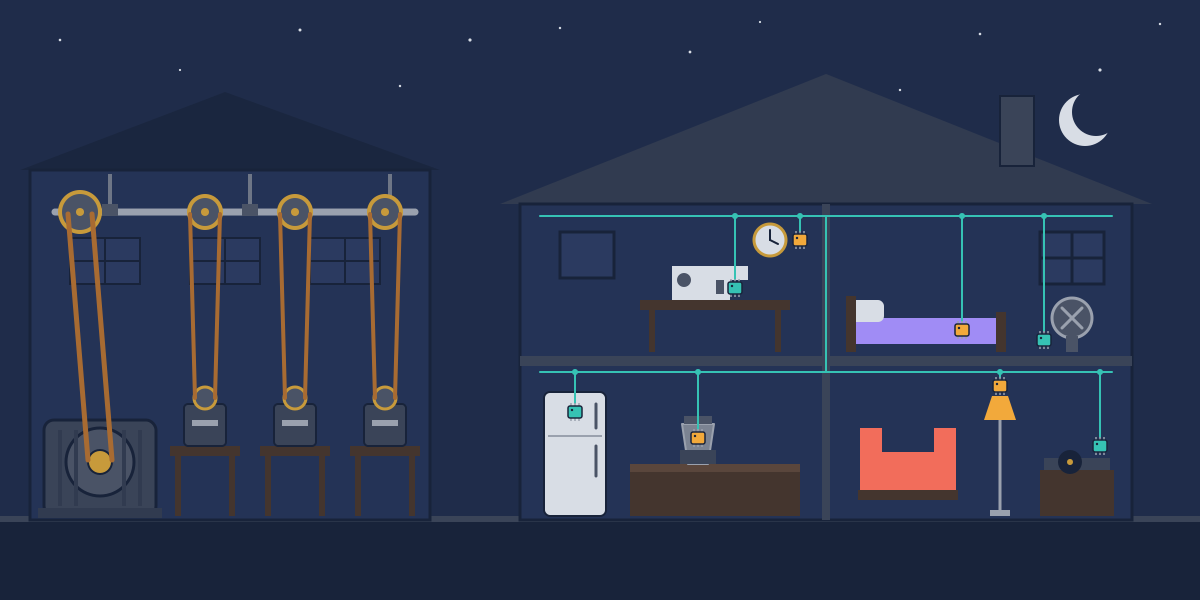
On 15 June 1983, six months before the Macintosh, Steve Jobs told the International Design Conference in Aspen a story about electric motors. The first ones could only be built very large, so they could "only be cost justified for very large applications". Then someone ran a shaft through a factory and, "through a series of belts and pulleys", shared one motor among "15 or 20 medium-sized workstations". "But the real breakthrough was the invention of the fractional horsepower electric motor," he said. "We could then bring the horsepower directly to where it was needed and cost justify it on a totally individual application. And I think there's about 55 or so fractional horsepower motors now in every household." Computers, he argued, were going the same way: from one large machine shared by many people to one machine for each.
The Antheos Protocol, Version 1.10, takes the story one step further. Its design note says a traditional operating system "answers a scarcity question: one expensive processor multiplexed across many tasks by a privileged arbiter" (Section 1.1). That arbiter is the shaft and the belts. When every device carries a processor of its own, the note goes on, the machine is "a small network of peers, and what those peers need is not a kernel but a shared communication law". Antheos means to be that law, and at every size: "It runs on all devices from MCU to server cluster" (Section 1).
The small processors arrived as the motors did. IoT Analytics counted 18.5 billion connected IoT devices in 2024 and expects 39 billion by 2030. Arm said in May 2026 that more than 350 billion chips built on its designs had shipped. Espressif, which makes small Wi-Fi chips, passed a billion in 2023. A modern car may carry as many as 70 electronic control units.
Asked in Aspen how all these computers would work together, Jobs answered: "They all speak different languages right now." Forty-three years later they still do. This essay sets Antheos beside the languages they speak: what is already there, where Antheos differs, and what the world now asks of anything that reaches a device. Antheos is four specifications and no published implementation, so this compares a text with practice, and the text gets no credit for what practice has not yet tested.
Fifteen competing standards
In 2011 the webcomic xkcd drew the problem every universal protocol meets. Its first panel reads "There are 14 competing standards". Someone sets out to write "one universal standard that covers everyone's use cases", and the last panel reads "There are 15 competing standards".
The protocols a small device speaks today were each made for one job at one distance:
| Protocol | First published | Made for |
|---|---|---|
| Modbus | 1979, by Modicon | Controllers on a factory floor |
| I²C | 1980, by Philips | Chips on one circuit board |
| CAN | 1986, by Bosch | Control units in a car, first in a production car in 1991 |
| MQTT | The late 1990s, by Andy Stanford-Clark and Arlen Nipper | Telemetry from oil pipelines |
| Zigbee | 2004 | Low-power radio meshes |
| Bluetooth Low Energy | 2010, in Bluetooth 4.0 | Small battery devices near a phone |
| CoAP | 2014, as RFC 7252 | Web-style requests on constrained networks |
| Matter | 2022 | Smart-home devices from rival makers |
Where two of them meet, a gateway translates. A temperature read from a sensor on a board, sent across a radio mesh and published to a server can pass through three languages and two translators on the way.
Antheos does not set out to replace any of these links. It is carried by "any transport that can carry bytes", and "No message names a bus or a kind of bus" (Section 2). What it would replace is the translating above the links.
That makes its nearest relatives not the protocols in the table but two designs from operating systems. Plan 9 from Bell Labs, released to universities in 1992, had every program that offers a service "speak a unified protocol, called 9P". In 2008 Rusty Russell proposed virtio, in a paper titled "Towards a De-Facto Standard For Virtual I/O Devices": a virtual machine's drivers agree on a device's features once, then pass its data through rings of shared memory. Antheos's design note finds the same split between a control path and a data path in "production paravirtualized device interfaces" (Section 1.1).
By xkcd's count, then, Antheos is the sixteenth standard. Whether it becomes one more beside the others or a common law under them depends on the parts of the text this essay turns to next.
Old bytes with new faces
Every Antheos message begins with byte 0x02, and its head ends with 0x03 (Section 4.1). Those bytes are older than the personal computer. They are STX and ETX, start of text and end of text, and IBM's Binary Synchronous Communication protocol, BISYNC, "developed by IBM in the late 1960s", framed its messages between them, as Peterson and Davie's textbook describes.
They also have faces. Code page 437, the character set of the IBM PC of 1981, gave the control bytes printable glyphs, and Antheos reserves seven of them as delimiters (Section 4.1):
| Glyph | Byte | Its ASCII name | What it marks in Antheos |
|---|---|---|---|
| ☻ | 0x02 | STX, start of text | The start of a message |
| ♥ | 0x03 | ETX, end of text | The end of its head |
| ♦ | 0x04 | EOT, end of transmission | A radix flag |
| • | 0x07 | BEL, bell | A unit flag |
| ► | 0x10 | DLE, data link escape | The end of a word |
| ↕ | 0x12 | DC2, device control 2 | The start of a word |
| → | 0x1A | SUB, substitute | The start of a word's body |
One of them is a byte BISYNC already knew. It put DLE before an ETX that appeared inside a frame's body, so that the receiver would not take it for the end. Antheos needs no escape: the seven bytes are forbidden in the words of a head (Section 4.1), and DLE is one of its delimiters.
A display that renders CP437 "shows a head as written" (Section 2). A Ping to the instance at bus address 4T9X2 is 18 bytes, and it reads as it was sent:
☻↕!→P►↕@♦U→4T9X2►♥Legibility has a price, and most of the world has declined to pay it. MQTT's smallest control message is two bytes, and a CoAP message "starts with a fixed-size 4-byte header". By that count the Ping is nine times MQTT's smallest.
On a slow radio the price is smaller than it looks. LoRa, the long-range radio, carries 250 bits a second at its slowest European setting, SF12, and 5,470 at SF7. The table below is this essay's estimate from the standard LoRa time-on-air formula, with an 8-symbol preamble, an explicit header, a checksum and coding rate 4/5 at 125 kHz:
| What is sent | Bytes | On air at SF7 | On air at SF12 |
|---|---|---|---|
| A 2-byte message, MQTT's smallest | 2 | 31 ms | 0.83 s |
| An Antheos Ping | 18 | 52 ms | 1.32 s |
| A sealed handshake through its first answer, in four frames | 392 | 0.68 s | 15.9 s |
The radio's own preamble and header cost more than the readable head does. What limits a LoRa device in Europe is the duty cycle: in most of the band it may transmit 1% of the time, which The Things Network puts at 864 seconds a day. At SF12 that is about 650 Pings a day. The handshake in the last row is the Security draft's own example, which it costs at "about 0.3 s on the wire" on a bus carrying about 1.4 kB/s (Security Section 12). At SF12 the side that opens it is on air for about 8.7 seconds, about 1% of its daily allowance. A designer would plan for that, but it does not rule LoRa out.
The head also asks for an exactness that most formats do not. Every value has one spelling (Section 6.1): an integer has no leading zero, and a real number must be exactly representable in the IEEE 754 format its word declares. The decimal 0.1 is "not representable in binary floating-point of any finite precision", so $♦D•W→0.1 is not a valid word, and nothing is rounded to make it one (Section 6.2.6). A real number on the wire is exactly the value a device holds.
Asking instead of announcing
On most networks, finding a device means it announces itself or answers a call for everything it has. Multicast DNS and DNS-SD, published in 2013, let a client ask for "the list of available instances of a given service type", and a device that registers a service "MUST send an unsolicited Multicast DNS response" carrying "all of its newly registered resource records" (RFC 6762, Section 8.3). The link format for small web servers on constrained devices defines a well-known resource whose GET "returns a set of links available from the server" (RFC 6690): the whole list, to anyone who asks.
What leaks this way is measurable. A 2023 study of local traffic in smart homes found "vulnerable devices, insecure use of network protocols, and sensitive data exposure by IoT devices", and evidence that mobile apps and third-party code carried that information to remote servers, "potentially for household fingerprinting, surveillance and cross-device tracking".
Phones learned to hide late. A fixed hardware address makes it "relatively easy to track this device by simple medium observation", as an RFC published in 2025 puts it, and that RFC reports that Android 10 and iOS 14, and their successors, now pick a random Wi-Fi address for each new network by default.
Antheos starts where the phones ended up. An instance draws a random base-32 address, its BID, each time it connects to a bus, and holds a separate one on each bus (Section 5.4). Level 1 carries none of the lasting identifiers it defines for a maker, a device type and a serial number (Section 5). Discovery is by asking: an instance that needs a capability sends a Query naming it, providers answer with an Offer, and the asker sends an Accept (Section 10). Offers sent without a Query "are prohibited" (Section 10.2), and so is an empty Query, since "a match-all interpretation would constitute the capability enumeration" the design forbids (Section 10.1). The well-known resource is such a match-all, and Antheos rules it out, as it rules out the unsolicited announcement.
The specification is plain about what this does not buy. A BID "links everything an instance does for as long as its bus connection lasts", and "A passive observer on a shared bus can catalogue available services by monitoring Query/Offer traffic" (Section 15). Antheos makes a listener wait for someone to ask. It does not stop anyone listening.
A world that now asks for locks
In 2016 a botnet called Mirai showed what open devices cost. It logged in over Telnet with names and passwords "selected randomly from a pre-configured list of 62 credentials", grew to "a peak of 600k infections", and on 21 October 2016 was turned on Dyn, a DNS provider, in a series of denial-of-service attacks.
Law followed. The United Kingdom's rules for connectable products, in effect since 29 April 2024, ban "universal default and easily guessable passwords". The European Union's Cyber Resilience Act, Regulation (EU) 2024/2847, has applied its reporting duties since 11 September 2026 and applies in full from 11 December 2027. Among its essential requirements, a product with digital elements is to be made available "with a secure by default configuration", and is to "protect the confidentiality of stored, transmitted or otherwise processed data, personal or other" (Annex I).
Antheos Level 1 "provides no encryption, authentication, or integrity protection" (Section 15), and says so before it lists the attacks that follow from it, from sender spoofing and forged Conflicts to route hijacking and session takeover. A device that carried confidential data over Level 1 alone would not protect it, by the specification's own account. Whether a given product meets the Act is for its maker and the law, not for this essay.
The drafts answer with layers, not modes. The Security draft, Version 0.4, seals the content of sessions with the Noise Protocol Framework, revision 34, the family of handshakes Trevor Perrin published. WireGuard builds on the same framework, and has been part of Linux since version 5.6, in March 2020. The draft allows one cipher suite, X25519 with ChaCha20-Poly1305 and SHA-256, and two handshakes (Security Section 4.1). Whether a session is sealed is fixed before it starts, and "It is never negotiated within the session, so nothing inside the layer can be downgraded" (Security Section 7.1). "There is no plaintext fallback" (Security Section 9). It also counts a key as an identity in the privacy sense: "A key used in two places links them for anyone who receives it" (Security Section 2).
The Defence draft, Version 0.1, guards the bus itself. It adds an HMAC-SHA-256 proof to every frame, 36 bytes more on the wire (Defence Section 14), and states that "The layer offers no availability" (Defence Section 15): a device that jams the wire still stops it.
Both drafts say that no cryptographer has reviewed them. The field's clock runs on meanwhile. NIST chose Ascon for lightweight cryptography on small devices in February 2023, and published ML-KEM, its first post-quantum key-encapsulation standard, as FIPS 203 in August 2024. The Security draft is "not post-quantum secure", because "A post-quantum key exchange adds kilobytes to a handshake, which is more than the smallest devices this layer serves can carry" (Security Section 13). That is an honest trade, and it is still open.
Running code
The IETF holds a specification back from being an Internet Standard until "There are at least two independent interoperating implementations with widespread deployment and successful operational experience" (RFC 6410, 2011). Antheos has none published. Level 1 is labelled stable. The Security draft has been "exercised in a model and on no bus", the Defence draft "in no model and on no bus", and the Object Layer "in no implementation and on no bus".
The parts to change that are not scarce: there are more than a billion of Espressif's chips alone. Level 1's floor is low enough for any of them. An instance must find where messages and words begin and end, claim a BID with Establish and Conflict, read the sizes of the binary blocks after a head, and drop whatever it cannot process (Section 14.1). Everything else is optional, and a feature is claimed whole or not at all (Section 14.2).
What the house would need
The 55 motors in Jobs's household never needed to speak. The processors that took over much of their work do, and much of what they say still passes through a hub, an app or a maker's servers: a shaft and belts, moved out of the house.
Antheos puts the other arrangement in writing. Peers share any wire, are anonymous by default, are found by asking and can be read by eye, and a session that is sealed cannot be talked back into the clear. Its own text names what it leaves open: the trail a BID leaves for as long as it lasts, the attacks Level 1 cannot stop, a post-quantum exchange still too large for the smallest devices, and no running code.
Jobs's answer in Aspen still describes the job: "They all speak different languages right now." A law for them is written. Whether it ends up the sixteenth standard or the common one will be settled when two strangers build it, apart, and their devices understand each other byte for byte.
Sources
- Antheos Protocol, Version 1.10, Level 1 Specification - Transport, cited by section
- Antheos Security Layer, Version 0.4, Level 2 Specification - Security, cited as Security
- Antheos Defence Layer, Version 0.1, Level 2 Specification - Defence, cited as Defence
- Antheos Object Layer, Version 0.2, Level 3 Specification - Objects
- Steve Jobs, talk at the International Design Conference in Aspen, 15 June 1983, quoted from a published transcript of its recording
- IoT Analytics, State of IoT 2025; Arm, results for its financial year 2026; Espressif, 1 billion chips
- CAN bus, Modbus, I²C, MQTT, Zigbee, Bluetooth Low Energy, Matter, Plan 9 from Bell Labs, Code page 437, C0 and C1 control codes, Half-precision and Floating-point arithmetic, Wikipedia
- xkcd 927, Standards
- RFC 7252 (CoAP), RFC 6762 and RFC 6763 (Multicast DNS and DNS-SD), RFC 6690 (CoRE Link Format), RFC 9724 (randomized MAC addresses) and RFC 6410 (the standards track), the RFC Editor
- Rusty Russell, virtio: Towards a De-Facto Standard For Virtual I/O Devices, 2008
- Larry Peterson and Bruce Davie, Computer Networks: A Systems Approach, Section 2.3, Framing
- The Things Network, EU863-870 regional parameters
- Girish and others, In the Room Where It Happens: Characterizing Local Communication and Threats in Smart Homes, IMC 2023
- Antonakakis and others, Understanding the Mirai Botnet, USENIX Security 2017
- The UK's regulations for consumer connectable product security, GOV.UK
- Regulation (EU) 2024/2847, the Cyber Resilience Act, EUR-Lex
- The Noise Protocol Framework; WireGuard, its protocol page; Linux 5.6, Kernel Newbies
- NIST, its selection of Ascon (2023) and FIPS 203 (2024)