What Hath God Wrought
Samuel Morse and the sentence he did not write
A morning in the Capitol
The most famous sentence in American technology was not Samuel Morse's, and it was not a question.
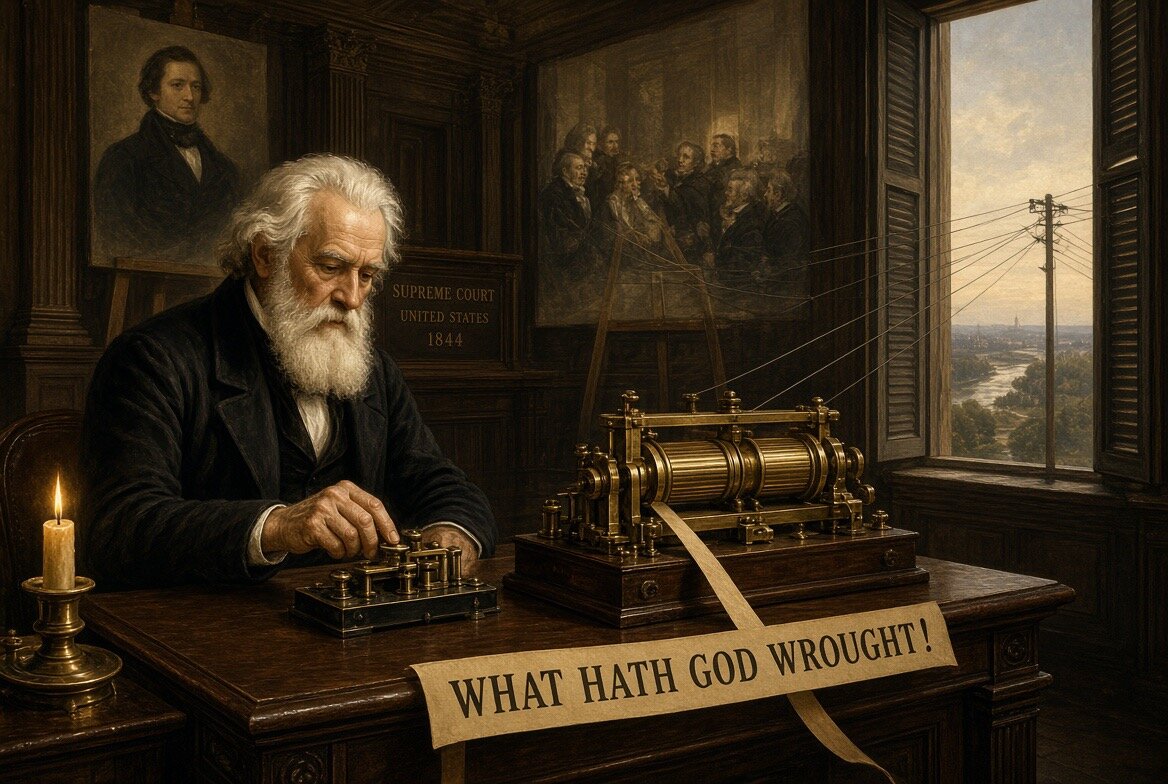
On 24 May 1844, Morse sat at a key in the Supreme Court chamber of the United States Capitol. About forty miles away, at a railroad depot in Baltimore, his partner Alfred Vail sat at the other end of a wire. Morse sent four words from the Book of Numbers, and Vail sent them back.
The words were chosen by a young woman named Annie Ellsworth. In the King James Bible they end in an exclamation mark, a cry of awe with no doubt in it. Yet the line has come down to us as Morse's, and as a question, and both errors say something true: one about who gets the credit for an invention, the other about how amazement turns into unease.
The painter
The inventor of the telegraph spent his first forty years trying to be a great painter, and he was a good one.
Morse was born in Charlestown, Massachusetts, in 1791, the son of Jedidiah Morse, a Calvinist minister and the country's best-known geographer. He graduated from Yale in 1810 and went to London to study under Washington Allston. He came home wanting to paint vast historical canvases for a republic that mostly wanted portraits.
He painted the portraits anyway, and he painted the ambitious pictures too: The House of Representatives in the early 1820s and Gallery of the Louvre in the early 1830s. He helped found the National Academy of Design in New York and became its first president. Neither picture made the money or the name he wanted.
The event that biographers return to came in February 1825. Morse was in Washington, working on a commission to paint Lafayette, when a letter arrived from his father. His wife Lucretia had died at home in New Haven, and by the time he got back she had been buried.
It is tempting to make that letter the origin of the telegraph, and the temptation should be resisted. Morse's idea came seven years later and from a different direction. Still, he knew better than most people what it meant for news to travel at the speed of a horse.
The idea came in the autumn of 1832, on the packet ship Sully, sailing home from Europe. A fellow passenger, the physician and geologist Charles Thomas Jackson, talked at table about the electromagnet and about electricity passing instantly through any length of wire. Morse filled a sketchbook with a scheme for sending signals that way, and Jackson later claimed the idea had been his.
The last door in painting closed in 1837, when Morse failed to win a commission for one of the Capitol Rotunda's history paintings. He largely stopped painting after that. Seven years later he was back in the same building, with a different kind of instrument.
The machine and its many hands
Morse earned the title of inventor by making a telegraph that worked, got paid for and spread, not by being first or by working alone.
Others had got there before him. France had run optical semaphore lines since the 1790s, Gauss and Weber signalled across Göttingen by wire in 1833, and Cooke and Wheatstone patented an electric needle telegraph in Britain in 1837. Morse's early apparatus, meanwhile, would barely carry a signal across a room.
Three men closed the gap between his sketch and a working line:
- Leonard Gale, a chemistry colleague at New York University, showed him that he needed batteries of many cells and magnets of many turns. That knowledge came largely from the published work of Joseph Henry.
- Alfred Vail, who joined in 1837, brought his family's ironworks at Speedwell, New Jersey, along with money and mechanical skill. He built much of the instrument, and historians still dispute how much of the dot-and-dash code was his.
- Ezra Cornell was hired to lay the first line. When the buried, insulated wire failed, the line went up on poles, which is how telegraph wires looked ever after.
Getting the money was its own ordeal. Morse patented the system in 1840 and spent years failing to find backers, in America and in Europe. In March 1843 Congress finally voted $30,000 for an experimental line from Washington to Baltimore. During the House debate one member, Cave Johnson of Tennessee, moved as a joke to give half of it to mesmerism.
That joke deserves remembering. About two dozen members voted for it, and the chair, asked to rule it out of order, declined, saying it would take a scientific analysis to tell how far the magnetism of mesmerism was like the telegraph's. The joke worked because a message passing through a wire could still be made to sound like a trance.
The Supreme Court eventually drew the line around Morse's achievement. In O'Reilly v. Morse (1854) it upheld his patents on the machinery but struck down his broadest claim, to the use of electromagnetism for marking characters at a distance by any means whatever. He owned what he had built, the Court held, and not the whole idea. Patent lawyers still cite the case.
The sentence
The line was a gift to Morse from a friend's daughter, and its source is a story about a man who could only transmit what he was given.
Annie Ellsworth was the daughter of Henry Leavitt Ellsworth, the Commissioner of Patents and a friend of Morse's. As Morse told it many years later, she brought him the news that the 1843 appropriation had passed, and he promised her the first dispatch on the completed line. She chose the verse, by his son's account in consultation with her mother, and Morse's own note on the surviving paper tape credits her.
The verse is Numbers 23:23, and the King James Version gives it this way:
Surely there is no enchantment against Jacob, neither is there any divination against Israel: according to this time it shall be said of Jacob and of Israel, What hath God wrought!
The speaker is Balaam, a seer hired by Balak, king of Moab, to curse the Israelites camped on his border. Three times Balak takes him to a high place and asks for a curse, and three times Balaam opens his mouth and a blessing comes out. "The word that God putteth in my mouth, that shall I speak," he warns in advance.
Nobody in 1844 needed to labour the parallel, but it is hard to miss now. Balaam is a channel: the message passes through him intact, whatever the sender paid for and whatever he might prefer. The verse also opens by denying that enchantment and divination have any power, which is an odd and apt thing to send down a wire that a congressman had joked about as mesmerism the year before.
Morse took the choice as more than apt. Writing to his brother Sidney, he called the sentence "divinely indited" and said it stayed in his thoughts day and night. For him it was a statement of fact about who had built the telegraph.
That is why the punctuation matters. The verse exclaims: look what God has done. The version most people now repeat asks, and a question invites an answer that Morse never thought he needed to give.
What the wire changed
The telegraph's real break with the past was that a message no longer had to travel with a messenger.
Before 1844, American news moved about as fast as a person could, by horse, ship or train. The communications scholar James Carey made this separation of communication from transport the centre of his account of the telegraph. Once it happened, the two could develop independently, and information could get ahead of the goods and people it concerned.
The first demonstration of what that meant came within days. The Democratic convention met in Baltimore in late May 1844, at the far end of Morse's new line, and nominated James K. Polk. It then chose Silas Wright for vice president, and Wright, in Washington, declined by telegraph. The delegates did not believe the wire and sent a committee to Washington to verify the dispatch.
They stopped doubting quickly. Within a generation the consequences were everywhere:
- Newspapers in New York began pooling the cost of transmitting news in 1846, the start of the Associated Press.
- Prices in distant markets drew closer together, because a merchant could now know them the same day.
- The transcontinental line of 1861 finished the Pony Express within days.
- In 1865 European states founded the International Telegraph Union in Paris, and adopted Morse's code, in a revised continental form, as the international telegraph alphabet.
- A lasting Atlantic cable in 1866 cut the news gap between Europe and America from about two weeks to minutes.
Daniel Walker Howe took the sentence as the title of his Pulitzer-winning history of the United States from 1815 to 1848. He treated the revolution in communications and transport as a defining force of the era.
Not everyone was impressed. Henry David Thoreau, writing in Walden in 1854, supplied the century's best reply to Annie Ellsworth's verse:
We are in great haste to construct a magnetic telegraph from Maine to Texas; but Maine and Texas, it may be, have nothing important to communicate.
He went on to predict that the first news through an Atlantic cable would be that a princess had whooping cough. It was a joke then, and every later network has made it look more like a forecast. Thoreau's question was the one Morse's verse had not asked: wrought, but for what?
The credit given to God
Morse's piety was sincere, and it did not make him humble.
He was a minister's son who believed that Providence had chosen him, and he said so in private letters where he had no audience to impress. Giving the telegraph to God was a real act of faith. It also had a convenient side effect, because a work of God needs only one chosen instrument, and that left little room for Henry, Vail or Jackson.
His conduct toward them was not otherworldly. He fought for sole priority in court and in print for years, and he publicly attacked Joseph Henry, whose published science he had relied on and who had advised him freely. Vail, who had made the instrument work, ended his life comparatively obscure, while Morse grew rich and bought an estate at Locust Grove on the Hudson.
The same certainty shaped his politics, and the record there is ugly. In 1835 he published Foreign Conspiracy Against the Liberties of the United States, arguing that Catholic powers in Europe were using immigrants to subvert the republic. In 1836 he ran for mayor of New York on a nativist ticket and lost badly.
From the 1850s through the Civil War he defended slavery on scriptural grounds, in his letters and in a pamphlet published in 1863. "Slavery per se is not sin," he wrote, describing it as ordained by Divine Wisdom. He read God's will in the Bible as confidently as he had read it in the wire.
His admirers sometimes treat this as a stain on an otherwise clean record, a separate fact about a great man. It is better understood as the same habit applied elsewhere. A person who is sure that God wrought his successes has a ready way of not examining them, and of not examining much else.
He also gave generously, to Vassar College, to Yale and to Union Theological Seminary, where he endowed a lectureship. None of that cancels the rest, and the rest does not cancel the telegraph. Morse did real good and real harm, and he believed both had divine approval.
The exclamation and the question
The exclamation mark belonged to Morse, and the question mark belongs to everyone who has inherited his wire.
On 10 June 1871, when Morse was eighty, a statue of him was unveiled in Central Park. That evening at the Academy of Music, a farewell message went out over the lines to operators around the world, and the old man sat down at the key to sign it himself:
Greeting and thanks to the Telegraph fraternity throughout the world. Glory to God in the highest, on earth peace, good will to men.
He died in New York the following April. The second half of that message is the angels' song from Luke, and it was a hope more than a report. By 1871 the wires had carried prices, gossip and love letters, and also the orders of the Civil War.
Nobody decided to turn the verse into a question. It happened in the retelling, and it may be the best edit the sentence ever received. Morse knew what God had wrought and sent the line as praise, while later readers, knowing what came of it, hear it as an inquiry.
The wires had shown early how quickly one mark could follow the other. When Cyrus Field's first Atlantic cable was completed in August 1858, Queen Victoria's greeting of 98 words to President Buchanan took about sixteen hours to send, and New York's celebration ended with its fireworks setting the cupola of City Hall on fire. Within weeks the cable was dead, damaged in part by the high voltages its electrician, Wildman Whitehouse, drove through it.
Western Union sent its last telegram in 2006, but the sentence has outlived the service. Every new network since has been greeted with both marks, usually in the same order: first the one Morse meant, then the one we gave him.
Sources
- Samuel F. B. Morse, His Letters and Journals, edited by his son Edward Lind Morse (1914), two volumes, Project Gutenberg; his son is partial to him
- Numbers, King James Version, Wikisource
- Walden, Project Gutenberg
- O'Reilly v. Morse, Legal Information Institute, Cornell Law School
- Samuel Morse, Alfred Vail, Ezra Cornell, Leonard Gale, Silas Wright, Semaphore line, Electrical telegraph, Transatlantic telegraph cable, Associated Press, Western Union, International Telecommunication Union, James W. Carey and What Hath God Wrought (book), Wikipedia
- The first transatlantic telegraph cable 1858, IET Archives; The Underwater Web: Cabling the Seas, Smithsonian Institution Libraries
- Samuel Morse, Lemelson-MIT
- The gains from improved market efficiency: trade before and after the transatlantic telegraph, European Review of Economic History
- The Library of Congress catalogue record for the tape, a State Historical Society of Iowa page on it and a U.S. Senate history of the line, read only as search excerpts
- Not consulted: Kenneth Silverman's Lightning Man (2003), Carleton Mabee's The American Leonardo (1943) and Daniel Walker Howe's What Hath God Wrought (2007)