The City's Breath: The Pneumatic Post of Paris
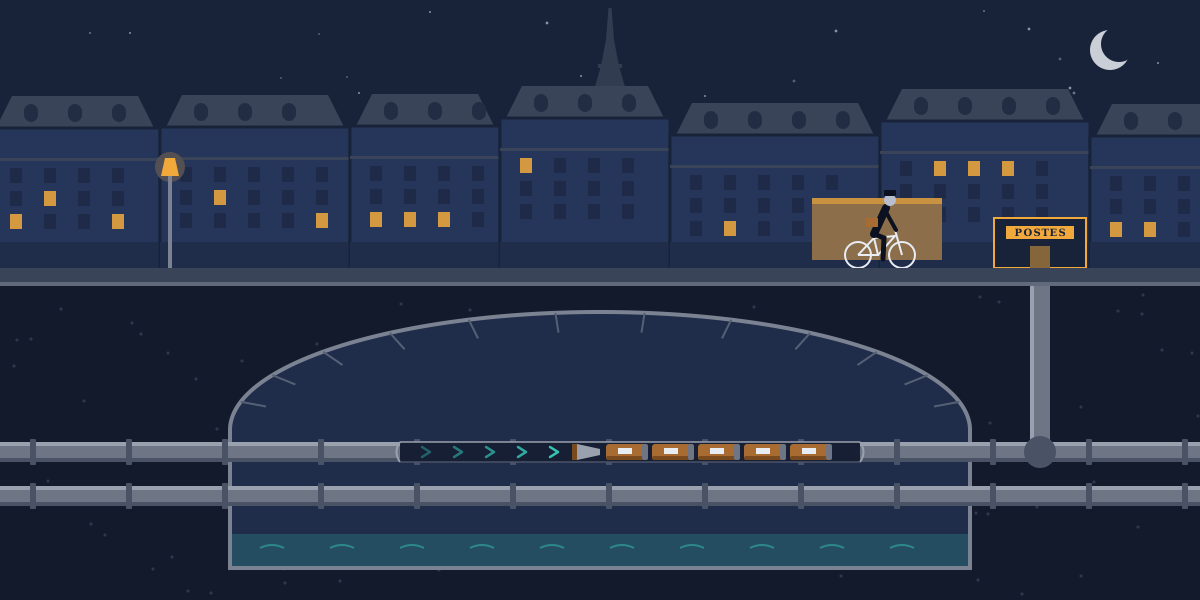
For 118 years, Paris moved its most urgent messages through pipes of compressed air beneath its streets. The Paris pneumatic post ran from 1866 to 1984, and at its height it was, by one account, the largest network of its kind in the world.
Its charm lies in what it carried. A telegram turned words into signals and back again, but a pneumatic letter stayed paper the whole way, still in the sender's handwriting. In the early 1900s it could reach the other side of the city in about an hour, pushed through the sewers by air and finished by a courier on a bicycle.
A patch for a congested telegraph
The system began as a repair to the telegraph, not a rival to it. Telegraph lines were overloaded, so messages were sent on by carriage, and carriages got stuck in traffic. A tube offered a way under the jam.
Paris was not the first to try it. Ambroise Ador tested a pneumatic system in Parc Monceau in 1852, and Josiah Latimer Clark linked the London Stock Exchange to the Electric Telegraph Company in 1853. Antoine Galy-Cazalat ran more Paris tests in 1854, and Berlin's Rohrpost arrived in 1865.
The first Paris line opened in December 1866 and was about 1 km long. Wikipedia has it running from the central telegraph office on Rue Feydeau to the Grand Hôtel on Boulevard des Capucines, while Cabinet describes a link between the stock exchange and the telegraph office. By 1867 it had grown into a six-station hexagon, and by 1872 it had doubled in size.
Air, sewers and brass
The machine ran on a difference in air pressure. On the first line, reservoirs under a 15 m head of water produced air at 2 atmospheres. That air drove a 14 cm carrier through a 65 mm tube, and a carrier holding 40 messages crossed the line in 60 to 80 seconds.
The route was the clever part. The first tube was buried 1 m down, but the wider network ran along the vaulted sewers built under Baron Haussmann during the Second Empire. Paris had already dug the tunnels, and they ran beneath the traffic that had caused the problem.
Power changed as the network grew. The compressed-air stations were steam-powered at first, and complaints about smoke led to costly flue gas scrubbers in 1926. Electrification began in 1927 and finished in 1942. Louis Gaillard, who ran the whole network until 1974, also pioneered automatic sorting of messages by address.
The petit bleu
The public got access on 1 May 1879, after the new Ministry of Posts and Telegraphs took over the network. Messages were legally telegrams, but their price did not depend on length. A legend on an 1882 letter told senders there was no limit to the words they could write on the back.
Users wrote on pre-franked forms called petits bleus, or "small blues", and left them in boxes or at telegraph counters. Couriers, some as young as 14, carried each message the last stretch on foot or by bicycle, and by moped from 1930. Coverage spread across the city in four phases between 1882 and 1884.
The flat price changed what the service was for. Freed from paying by the word, people used it for dates and rejections, where tone mattered more than it could in a telegram. By 1907 the network had 210 km of tubes and handled about nine million postal telegrams a year.
In history and fiction
The most consequential petit bleu in French history was never sent. Colonel Max von Schwartzkoppen, the German military attaché, tore it into more than fifty pieces and threw it away. In March 1896 the scraps reached French army intelligence, where Captain Lauth pasted them back together and found a note addressed to Major Esterhazy.
The note set Georges Picquart on Esterhazy's trail. Picquart found that Esterhazy's handwriting matched the bordereau, the document behind Alfred Dreyfus's conviction for treason, and concluded that Dreyfus was the victim of a judicial error. His superiors told him to "separate the two affairs", then moved him out of the way, eventually to Tunis.
Fiction used the pneu more gently. It turns up in Maurice Leblanc's Arsène Lupin stories, and in François Truffaut's Stolen Kisses (1968), Antoine Doinel drops a farewell letter to Madame Tabard into a slot marked PNEUMATIQUES. The name outlived the service too: two regional newspapers called Le Petit Bleu still exist.
Decline and closure
The network peaked around the 1930s and 1940s, though sources disagree on its size. Wikipedia gives 427 km and 130 offices in 1934, Cabinet gives 450 km in 1945, and The Connexion gives 467 km. For 1945 traffic, Wikipedia says 30 million messages and Cabinet says twelve million objects.
After 1945 the numbers run one way. Budget cuts slowed maintenance, and by 1966 some 65% of the 65 mm tubes were worn. In 1970, 270 blockages sent workmen into the sewers, and PVC replacements covered only 18 km. A pneumatic message cost about 3 times a letter in 1902 and 7.8 times by 1975, while traffic fell from 4 million messages in 1960 to 648,000 in 1982.
The service stopped at 5 pm on 30 March 1984, replaced by Postéclair, a public fax service, and Postexpress, a parcel service. Most staff moved to Postexpress. One separate line linking the Senate and National Assembly to the Journal Officiel survived until 2004, and short sections of tube are said to lie forgotten in the sewers still.
Paris was neither the first city to close its tubes nor the last. Vienna's pneumatic post ran from 1875 to 1956, and Berlin's until 1976. Prague's opened in 1887 for the post office's own use and entered public service in 1889, and it worked until the floods of August 2002 submerged five of its eleven engine rooms; it carried no more post after that. A new owner promised in 2012 to restore it.
What it leaves behind
The pneumatic post shows how far a network can drift from its purpose. A 1 km repair for telegraph traffic became hundreds of kilometres of public infrastructure, and then a way to break off a romance. A pricing rule did as much of that work as the engineering, because a flat fee invited people to write at length.
It also shows how such a network ends. Telephones and fax machines took away the urgency, while worn tubes and rising prices took away the economics, and the two together emptied it over about forty years.
What went with it was a small and particular thing. The fax that replaced it could copy a person's handwriting across the city, but it could not deliver the sheet of paper they had written on.
Sources
- Paris pneumatic post, Wikipedia
- Interfacing with the Subterranean, Cabinet magazine (read only as far as its paywall)
- Georges Picquart's investigations of the Dreyfus affair, Wikipedia
- A love letter to the lost world of the Parisian pneumatic post, Messy Nessy Chic
- Paris tube message system ran to 1984, The Connexion
- Pendant 118 ans, le courrier filait sous Paris dans des tubes à 40 km/h, Paris ZigZag
- Pneumatic post and Prague pneumatic post, Wikipedia
- New owner promises bright future for world's largest pneumatic post system, Radio Prague International