Did a collider see matter come from nothing?
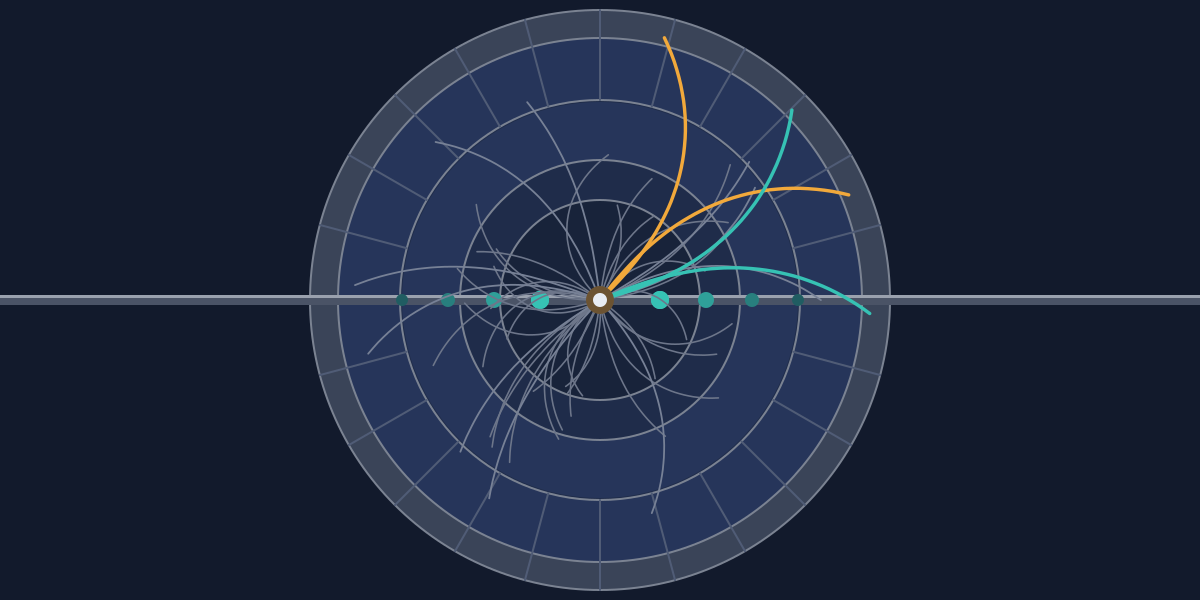
“A particle collider showed matter emerging from ‘nothing’ in a quantum vacuum.”
That was the caption on a post by @MAstronomers. It was laid over an image of a collider tunnel and the rings of a particle display. The post pointed to a 2026 result from the STAR experiment at Brookhaven’s Relativistic Heavy Ion Collider. It said proton collisions had “promoted fleeting virtual pairs into detectable real particles.” It also said this fits the QCD picture of a dynamic vacuum rather than an empty one.
The short answer is no. No matter came from nothing. Every new particle in the experiment was paid for by the energy of two protons colliding head-on, as at every particle accelerator since the 1950s. The word “nothingness” comes from the laboratory’s press release, not from the paper.
What STAR found is subtler. Λ–anti-Λ pairs that leave the collision in similar directions carry a spin correlation: their spins line up more often than uncorrelated spins would. STAR reads this as the trace of a strange quark and its antiquark that came out of the vacuum with aligned spins. The collision supplied the energy for the matter. If STAR’s reading holds, the vacuum supplied a pattern in how that matter spins.
What was measured
STAR analysed about 600 million proton–proton collisions, recorded in 2012 at a centre-of-mass energy of 200 GeV. In each collision it looked for Λ (lambda) hyperons and their antiparticles. A Λ is a baryon made of an up, a down and a strange quark. It lives about 2.6 × 10⁻¹⁰ seconds. About two times in three it then decays into a proton and a negative pion, and that is the decay STAR uses. An anti-Λ gives an antiproton and a positive pion.
That decay is what makes the experiment possible. The proton tends to leave along the direction of the Λ’s spin, so the decay reports the spin. In the simplest quark model, the up and down quarks pair off with no net spin, and the Λ’s spin is the strange quark’s spin. In that model, then, the spin of a Λ made directly in the collision stands in for the spin of its strange quark.
For each Λ–anti-Λ pair, STAR boosted the proton and the antiproton into their parents’ rest frames and measured the angle θ* between them. If the two spins are correlated, that angle is not spread evenly. It follows
(1/N) dN / d cos θ* = ½ [ 1 + α₁ α₂ P cos θ* ]Here α₁ and α₂ are the decay asymmetry parameters (0.747 for the Λ, −0.757 for the anti-Λ), and P is the quantity sought: the pair’s relative polarization. It measures how strongly the two spins line up, summed over the three directions in space and divided by three. For two spin-½ particles it runs from −1 to +1/3. Spins in a triplet state, with total spin one and loosely called parallel, give the top value, 1/3: in any triplet state ⟨σ₁·σ₂⟩ = +1, and projecting the correlation onto a single opening angle divides it by three. The bottom value, −1, belongs to the singlet alone, where the spins point opposite ways along every axis at once. P = 0 means no net correlation, though correlations along different axes could in principle cancel.
The two decay parameters are themselves the product of entangled pairs. In 2019 the BESIII experiment in Beijing measured the Λ’s from Λ–anti-Λ pairs made in J/ψ decays, whose spins are entangled, and found it about 17% higher than the world average of the time. The Particle Data Group’s 2024 values, 0.747 and −0.757, are the ones used here.
That range has a consequence the coverage missed. The singlet is entangled, and no unentangled pair can reach its value: spins that are merely opposite along one axis give −1/3. At the other end there is no such gap. Unentangled spins that simply point the same way also give 1/3, the same as the triplet. So pairs that are not entangled can produce any P from −1/3 to +1/3, and only a value below −1/3 proves entanglement. STAR’s positive P shows that the spins are aligned. It cannot show that they are entangled. The preprint’s first version was titled for spin entanglement, and its abstract took the initial pairs to be entangled. That is the model the result is read against, not something the measurement establishes. The version published in Nature is titled for spin correlation instead, as is the preprint’s revision of February 2026, whose abstract speaks of “spin-correlated” virtual pairs. The laboratory’s release is more careful: “We need further measurements to see if this is a mix of entangled states or a more classically correlated system.”
The bound is not this essay’s invention, and a collider has crossed it. In 2023 the ATLAS experiment at the LHC measured, in top-quark pairs, a quantity D defined exactly as P is here, “tr[C]/3”, from the angle between decay products in their parents’ rest frames, the method STAR uses. ATLAS took “D < −1/3” as its test for entanglement and measured D = −0.537 ± 0.002 ± 0.019, more than five standard deviations from no entanglement; the result was published in Nature in 2024, and CMS reported its own observation the same year. Below −1/3, one opening angle can prove entanglement. STAR’s value lies on the other side.
The results depend on how closely the two hyperons’ directions of flight agree. Δy is the difference in rapidity, a measure of velocity along the beam, and Δφ the difference in angle around it. These are separations in momentum, not in position, and each row is a different set of pairs:
| Pairs | Selection | P |
|---|---|---|
| Λ–anti-Λ, similar directions | |Δy| < 0.5 and |Δφ| < π/3 | 0.181 ± 0.035 ± 0.022 |
| Λ–anti-Λ, close in angle, far in rapidity (a check on the production plane) | |Δφ| < π/3, |Δy| > 0.6 | −0.012 ± 0.073 ± 0.022 |
| Λ–anti-Λ, different directions | 0.5 < |Δy| < 2.0 and/or π/3 < |Δφ| < π | consistent with zero |
| Λ–Λ and anti-Λ–anti-Λ, any separation | — | consistent with zero |
The Λ–anti-Λ pairs moving in similar directions show a positive correlation at 4.4 standard deviations from zero. Pairs moving in different directions show none within errors. So do pairs of two Λs or two anti-Λs, which cannot share one strange quark–antiquark pair. Two baselines were also flat, as they should be: pairs of spinless K⁰ₛ mesons, and a standard simulation with no Λ spin physics in it.
The second row tests a different explanation: that each hyperon’s spin lines up with a common production plane, the plane of the beam and the hyperon’s flight, rather than with its partner’s spin. It came out flat, which argues against that explanation, but only weakly. Its uncertainty is about twice the signal’s statistical error, and it sits only some 2 to 2.5 standard deviations below the short-range value.
Why anyone says “vacuum”
Modern physics does not treat the vacuum as empty. In quantum chromodynamics, the theory of quarks and gluons, the lowest-energy state carries a condensate of virtual quark–antiquark pairs. Its presence signals that the vacuum breaks a symmetry of the theory, chiral symmetry. That breaking is closely tied to where most of the mass of ordinary matter comes from, though exactly how is still an open question.
The vacuum has definite quantum numbers: total angular momentum zero, positive parity, positive charge conjugation (Jᴾᶜ = 0⁺⁺). A quark–antiquark pair with those numbers must have one unit of orbital angular momentum and total spin one. Physicists write this ³P₀. The STAR collaboration’s reading is that the collision frees such a strange pair, that each quark then binds with other quarks into a hadron, and that the spins stay aligned long enough to show up in the Λ–anti-Λ pair. The paper calls the freshly made pair maximally entangled. That is true only once the direction in which the two quarks fly apart is fixed. A single opening angle does not use that direction: it gives the same P however the pair is turned, so it returns the same value for that entangled state as for an unentangled mixture of aligned spins. That is one more reason the measured P cannot settle the question.
Where the headline goes wrong
“From nothing.” The vacuum in this story is the opposite of nothing. It is a structured state, and its structure is the point of the measurement. A Λ–anti-Λ pair has a mass of about 2.2 GeV/c², and each collision had a centre-of-mass energy of 200 GeV. Turning collision energy into new particles is routine: antiprotons were first made this way in 1955, by a beam from the Bevatron striking a fixed target. The novelty is in the spin of the new particles, not in their appearing. The “nothingness” came from the press release, which spoke of transforming virtual “nothingness” into the matter that makes up our world.
In health research, that pattern has been measured. Sumner and colleagues studied 462 press releases on health-related science from twenty British universities, and 668 news stories, and concluded that “exaggeration in news is strongly associated with exaggeration in press releases” (BMJ, 2014).
Physics does describe pairs drawn out of the vacuum, and even those are paid for. In the Schwinger effect, foreseen by Fritz Sauter in 1931 and worked out by Julian Schwinger in 1951, an electric field strong enough would tear electron–positron pairs out of the vacuum, and the field would supply their energy. The vacuum’s structure can also be measured directly: Hendrik Casimir predicted in 1948 a force between two close metal plates, and Steve Lamoreaux measured it in 1997.
“Promotes virtual pairs into real particles.” Here the post is close to the paper. The paper says that virtual pairs from the vacuum “can be liberated and materialise into real particles,” and it calls the correlation “strong evidence for the presence of vacuum quark pairs.” That is a fair statement of the model, but it is an interpretation of a correlation, not something seen directly. Quark pairs can also come from a gluon splitting in two, and that alternative matters more than it first seems. A strange pair from a split gluon also has total spin one, so it would leave a correlation of the same sign. The measured value alone cannot tell the two sources apart. The vacuum reading rests on a simulation, which found gluon splitting negligible at the momenta measured, and the authors expect it to matter more at higher momentum.
“Showed.” STAR’s main word is evidence, and that is the right one, though its summary slips once into “observation.” Particle physics usually reserves “observation” for five standard deviations. This result stands at 4.4, from one experiment and one dataset. And the 4.4 measures how sure we can be that the correlation is not zero, not how sure we can be that it comes from the vacuum.
How strong is it, really?
A measured 18% sits well below the 33% that perfectly aligned spins would give, and that is expected. Most measured Λs are not born directly in the collision. In PYTHIA 8.2 events run through STAR’s detector simulation, only 11% of the pairs have both hyperons primary. The rest include at least one Λ from the decay of a heavier particle, most often a Σ⁰. Each such decay dilutes the spin information. In the simple quark model, a Λ from a Σ⁰ keeps a ninth of it.
Folding those fractions together, STAR computes what a fully aligned strange pair should leave behind. The simple quark model, SU(6), predicts 9.6 ± 0.4%. The Burkardt–Jaffe model gives the strange quark only 0.63 of a directly made Λ’s spin rather than all of it, and assigns different values to the decays that feed Λs into the sample; folded the same way, it predicts 1.5 ± 0.2%. The measurement sits about 4 standard deviations above Burkardt–Jaffe, which the paper calls disfavoured. Taken as one sample, the short-range pairs also sit about 2 standard deviations above SU(6). The paper calls the data compatible with SU(6) “within the uncertainty at small ΔR,” where ΔR = √(Δy² + Δφ²) combines the two separations. SU(6) already assumes that the strange pair starts fully aligned and that a directly made Λ keeps all of its quark’s spin. So an excess could not come from stronger alignment. It would have to come from the feed-down side, with more direct Λs or more spin surviving the decays than the simulation and the model allow, or be a statistical fluctuation.
The effect is small in absolute terms. With these decay parameters, P = 0.181 tilts the angle distribution so that for every 100 proton–antiproton pairs opening at under 90°, about 111 open wider. Measuring a tilt that slight to ±0.035 needs, at the very least, some 7,700 clean pairs. About one candidate pair in eight or nine is background, and the acceptance correction costs a little more, so the real sample is somewhat larger, but not by much. What takes hundreds of millions of collisions is how rarely a usable close pair turns up: roughly once in tens of thousands of collisions.
The systematic uncertainty of 0.022 combines six sources in quadrature. Four are variations of the selection. One is the residual the event-mixing correction leaves on a simulation with no spin correlation in it, and one is the uncertainty of the decay parameters. The largest are the event-mixing residual and the decay-vertex selection.
Two caveats deserve stating. The first is the paper’s own. The feed-down fractions come from simulation, and their uncertainty is “unknown and thus not considered.” The second is ours. The prediction multiplies two unknowns: how aligned the strange pair starts, and how much of that alignment each Λ inherits. The paper fixes the first at 100% to compare the two models of the second. Calling SU(6) compatible needs that assumption. Ranking Burkardt–Jaffe below SU(6) does not: any alignment below 100% shrinks both predictions alike, and Burkardt–Jaffe falls even further short. Neither caveat is a flaw, but more of the same data will not remove either. The first needs measured feed-down fractions or a validated model of them. The second needs an independent handle on one of the two factors.
What it does mean
If the reading holds, this gives a new handle on confinement, one of the least understood processes in the Standard Model. Quarks are never seen alone. The step by which they bind into hadrons happens in a regime where QCD resists calculation. Here is a property of a quark pair, the alignment of two spins, that seems to survive that step and stay readable in the hadrons. That does not show confinement happening, but it constrains how it can happen.
Its fading for pairs that fly apart in different directions is consistent with decoherence inside the collision. The paper names a plainer cause as well: a Λ and an anti-Λ from two different strange pairs share no correlation, and such mixed pairs dilute the signal. A fuller analysis, measuring the correlation along fixed axes rather than through one opening angle, could test Bell-type inequalities on pairs made by the strong force. Such a test would be limited, as all collider tests of this kind are, because nobody chooses the direction along which each spin is measured. The photon experiments that won Alain Aspect, John Clauser and Anton Zeilinger the 2022 Nobel Prize in Physics, “for experiments with entangled photons, establishing the violation of Bell inequalities and pioneering quantum information science”, could choose it. The same method could map how the correlation changes with momentum as gluon splitting takes over. In heavy-ion collisions, where the condensate may melt and chiral symmetry be restored, the paper proposes looking for a different signature: a distinct Λ–anti-Λ correlation, particularly pairs in a spin-singlet state.
So: a collider did not see matter emerge from nothing. It turned collision energy into matter, as accelerators always have. What may be new is that pairs of the matter it made remember something of how they were made, in the way their spins line up. STAR reads that memory as the vacuum’s structure. Two questions stay open: whether the spins are entangled or only aligned, and how much of the correlation comes from the vacuum rather than from split gluons. That is less of a headline and more of a finding.
A note on checking
The arithmetic behind this essay was redone independently, not taken from the press coverage. That covers the values of P for the triplet (1/3), the singlet (−1) and unentangled pairs (±1/3), computed from the Pauli matrices, and the 4.4σ significance from the statistical and systematic errors. It covers the five quantified systematic components adding up to the stated 0.022; the sixth, from the decay parameters, is too small to change it. It also covers both model predictions, rebuilt from the paper’s feed-down fractions and polarizations, and the distances to them. The work was done in DKE, LangSyn’s deterministic knowledge engine, where each derived number traces back to the paper fact it came from. Every number taken from the paper matches it, and the two rebuilt predictions match the paper’s within their stated errors. Several numbers are not in the paper and were derived here: the range of P and its entanglement bound, the 111 per 100, the 7,700 pairs, and the distances of about 2 and 4 standard deviations. Two independent reviews checked the essay against the paper line by line, one by a Claude model and one by xAI’s Grok 4.7, which recomputed every derived number. The paragraphs on neighbouring results, from BESIII’s decay parameters to the Nobel Prize, were added on 7 November 2026 from the sources listed for them, not from the paper, and came after those reviews. A further review by a Claude model read the revised essay the same day, and its findings were checked against the sources before any sentence changed.
Sources
- Probing QCD Confinement with Spin Entanglement, STAR Collaboration, arXiv:2506.05499v1 (5 June 2025), the version read in full for this essay
- Measuring spin correlation between quarks during QCD confinement, STAR Collaboration, Nature 650, 65–71 (5 February 2026), the published version, whose abstract reports the same (18 ± 4)%
- Scientists Capture a Glimpse into the Quantum Vacuum, Brookhaven National Laboratory (4 February 2026), the press release behind the coverage
- Measurement of Λ hyperon spin-spin correlations in p+p collisions by the STAR experiment, J. Vanek for the STAR Collaboration, arXiv:2307.07373 (2023), conference proceedings from DIS2023
- Polarization and entanglement in baryon–antibaryon pair production in electron–positron annihilation, BESIII Collaboration, Nature Physics 15, 631–634 (2019), read as arXiv:1808.08917
- The Λ listing, Review of Particle Physics, Particle Data Group, Physical Review D 110, 030001 (2024)
- Observation of quantum entanglement in top-quark pairs using the ATLAS detector, ATLAS Collaboration, Nature 633, 542 (2024), read as arXiv:2311.07288v3
- Observation of quantum entanglement in top quark pair production in proton–proton collisions at √s = 13 TeV, CMS Collaboration, Reports on Progress in Physics 87, 117801 (2024), arXiv:2406.03976
- The association between exaggeration in health related science news and academic press releases, P. Sumner et al., BMJ 349, g7015 (2014), read as its abstract on Europe PMC
- Schwinger effect and Casimir effect, Wikipedia, and Demonstration of the Casimir Force in the 0.6 to 6 μm Range, S. K. Lamoreaux, Physical Review Letters 78, 5 (1997)
- The Nobel Prize in Physics 2022, press release, the Nobel Prize